
Case Study Quick Facts:
- Client: Leading snack food manufacturer
- Challenge: Downstream carton loading and palletizing interruptions forced product into temporary storage and created an inefficient manual packaging recovery process.
- Primary Bottleneck: Operators had to push recovered cartons through the automated labeler individually, delaying recovery and tying manual packaging to the production line.
- Solution: Sterling Engineering’s team developed a retrofit for six labeling systems, creating an independent, on-demand recovery labeling capability.
- Engineering: Custom mechanical design plus Rockwell PanelView 800 HMI and MicroLogix 1100 PLC controls integration.
- Key Capability: Operators can generate hundreds of shipper labels within minutes while using the same label formats and recipes as the production system.
- Operational Advantage: Manual recovery packaging can continue while the automated packaging line returns to normal production.
- Results: Reduced downtime, faster production recovery, improved throughput, greater manufacturing flexibility, consistent labeling, and maintained traceability.
The Story Behind the Solution
In high-volume food manufacturing, a disruption at one point on the packaging line can quickly create problems throughout production.
For one leading snack food manufacturer, recurring interruptions at the carton loading station and downstream palletizing equipment were creating exactly that challenge. Upstream production continued running, which meant finished snack bags had to be diverted into large bins until they could be packaged later.
The manufacturer already had a recovery process. The problem was that it was slow, labor-intensive, and dependent on the automated packaging line.
Sterling Engineering helped develop a smarter solution: an independent recovery labeling system that allowed operators to package diverted product manually while automated production returned to operation.
The result was a more flexible packaging process designed to reduce downtime, accelerate production recovery, and keep product moving.
When a Downstream Bottleneck Affects the Entire Packaging Line
The manufacturer’s process moved snack products through several stages, including batch generation, oven processing, bagging, carton loading, shipper labeling, palletizing, and stretch wrapping.
When the carton loading station or downstream equipment stopped, however, upstream production could not simply stop along with it. Operators diverted snack bags into large bins for temporary storage. Once the issue was resolved, those products still needed to be loaded into shipper cartons and properly labeled.
That created another bottleneck.
The existing recovery process required operators to manually load the cartons and then push the boxes through the automated Videojet 9550 labeling system one at a time. It worked, but it tied the recovery operation to the production labeling equipment and made it harder to get the automated line back into normal operation.
The manufacturer needed a way to separate the two processes.
The Engineering Challenge: Make Labeling Independent
The goal was straightforward: give operators the ability to produce the required shipper labels without relying on cartons moving through the automated production line. Achieving that required modifying the existing labeling technology without compromising the label formats, product recipes, consistency, or traceability the manufacturer already depended on.
Sterling Engineering’s team developed a control and mechanical retrofit for six labeling systems. The standard system used a product detection sensor to trigger label application as cartons traveled along the conveyor. The engineered recovery system changed that operating model. Instead of waiting for a carton to trigger each label, the modified system could generate batches of labels on demand.
Engineering a More Flexible Packaging Recovery System
The solution combined custom mechanical engineering with Rockwell Automation controls integration.
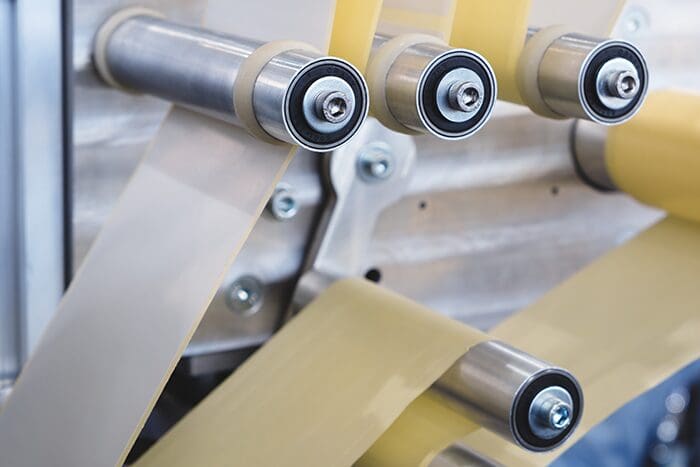
- Mechanical modifications included a custom label return roller arm assembly, HMI mounting bracket, and portable wheeled mounting platform.
- On the controls side, the system incorporated a Rockwell PanelView 800 HMI, MicroLogix 1100 PLC, dedicated controls enclosure, label system interface circuitry, and portable 120 VAC power package.
The PLC generated the print trigger pulses that would normally come from the carton detection sensor. This allowed operators to request and generate labels independently of cartons moving through the automated packaging line.
Just as importantly, the recovery system utilized the same label formats and product recipes as the production system, helping maintain labeling consistency and product traceability.
Hundreds of Labels in Minutes
The impact on the recovery process was significant. Instead of feeding cartons through the automated labeler one at a time, operators could generate hundreds of labels within minutes and apply them manually to recovered product.
That changed how the facility responded to downstream interruptions. Automated production could return to normal operation sooner while employees continued working through previously diverted product in parallel.
Rather than forcing the manufacturer to choose between production recovery and manual repackaging, the new system allowed both activities to happen simultaneously.
The Results: Faster Documentation, Better Accuracy, Greater Confidence
By replacing manual recordkeeping with an automated Batch Management and SCADA system, the facility transformed how it captured, stored, and accessed production data.
The new platform delivered measurable operational improvements, including:
- Automatic batch identification
- Complete electronic batch genealogy
- Barcode-based job tracking
- Automated process documentation
- Immediate report availability
- Reduced administrative workload
- Improved audit readiness
- Enhanced process traceability
- Faster customer response times
- More accurate production records
- Centralized electronic record retention
Beyond improving day-to-day operations, the new system created a digital foundation for future manufacturing initiatives, quality improvements, advanced reporting, and process optimization.
From a Production Workaround to a Purpose-Built Recovery Strategy
The solution demonstrates how targeted engineering modifications can address much larger operational challenges.
By creating an independent labeling capability, the manufacturer gained a reliable production recovery process that helped:
- Reduce packaging line downtime
- Restart automated production sooner
- Improve throughput
- Increase packaging flexibility
- Maintain consistent labeling
- Preserve product traceability
- Improve recovery from downstream equipment interruptions
What began as a labeling constraint ultimately became an opportunity to make the entire packaging operation more resilient.
For food and beverage manufacturers operating high-volume production lines, that flexibility matters. Not every manufacturing improvement requires replacing an entire production system. Sometimes, strategically modifying existing equipment can remove a critical bottleneck and create a more effective path to production recovery.
Engineering Solutions That Keep Production Moving
Manufacturing downtime can originate from a single piece of equipment, but its effects rarely stay isolated.
Sterling Engineering helps manufacturers identify those operational constraints and develop practical engineering solutions around existing processes and equipment. From controls integration and equipment modifications to process engineering and production optimization, the goal is to solve the engineering challenge while keeping the larger business objective in focus.
In this case, that meant something simple but valuable: getting the automated packaging line back to production faster.