
Case Study Quick Facts:
- Customer: Leading Machine Shop
- Equipment: 1984 Lagan 200-ton hydraulic press
- Challenge: Critical electronic controls were failing, and replacement parts were no longer available.
- Complication: The original equipment manufacturer was no longer in business, and technical support and documentation were limited.
- Opportunity: The press’s mechanical and hydraulic systems remained functional, creating an opportunity to modernize it instead of replacing it.
- Engineering Approach: The team assessed and reverse-engineered the existing machine control system to recreate its functionality using modern automation technology.
- Solution: A new PLC-based control architecture using Allen-Bradley CompactLogix and a 10-inch PanelView Plus HMI.
- Additional Improvements: Updated safety circuitry, machine diagnostics, alarm history, real-time status monitoring, digital parameter entry, and centralized machine controls.
- Result: The press returned to service without replacing its mechanical or hydraulic systems.
- Business Impact: The company avoided the substantial capital investment of replacing the press while gaining a more maintainable, supportable, and expandable control platform.
The Story Behind the Solution
A piece of manufacturing equipment does not necessarily reach the end of its useful life when its controls become obsolete. A local machine shop faced exactly that situation with a 1984 Lagan 200-ton hydraulic press. After decades of service, the press remained a valuable production asset. Mechanically and hydraulically, it could still do its job.
The controls were another story.
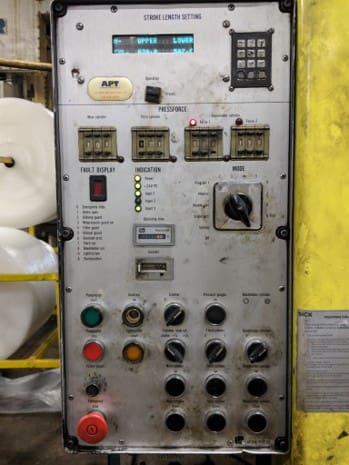
Original circuit boards had begun to fail. The Mitsubishi Sequence Controller at the heart of the machine was obsolete. Replacement components were unavailable, the original machine manufacturer was no longer in business, and technical documentation and factory support were limited or unavailable.
The company faced a difficult choice: replace a mechanically sound 200-ton press or find a way to modernize it. Sterling Engineering’s team developed another option.
The Challenge: A Good Machine Held Back by Obsolete Technology
Legacy equipment presents a familiar problem for manufacturers. A machine can continue performing its core mechanical function long after its electronic controls reach end of life. But once unsupported components begin failing, every breakdown becomes more difficult to solve.
That was happening with the Lagan press. Despite extensive searching, they could not locate spare parts, and unplanned downtime was becoming a growing threat to production schedules. Completely replacing the press would require substantial capital investment.
The question became: Could the machine be modernized without replacing what was still working?
Before designing a solution, the engineering team needed to understand exactly how a machine built more than four decades earlier operated.
Reverse Engineering a Machine Without Complete Documentation
The first step was not replacing hardware. It was understanding the existing system. The engineering team reviewed the electrical systems, analyzed operating sequences, collected measurements while the press was running, identified sensors and actuators, verified hydraulic interfaces, documented safety functions, and evaluated whether existing field devices could work with modern controls.
Because the original documentation was incomplete and the legacy electronics could no longer be supported, the team effectively had to reverse engineer the press’s control system and recreate its required functions using modern automation technology.
This assessment was critical. Rather than redesigning the entire machine, the team could focus the investment where it mattered most: the controls.
The Solution: Replace the Obsolete Controls, Not the Press
Instead of attempting another temporary repair, the engineering team designed an entirely new control architecture. The team consolidated multiple legacy control systems into a single integrated cabinet. The modernization incorporated an Allen-Bradley CompactLogix PLC, digital and analog I/O, a 10-inch PanelView Plus touchscreen HMI, new motor control and power distribution components, 24 VDC control power, updated circuit protection, emergency stop circuitry, and safety light curtain integration.
The result was more than a replacement for failed electronics. It changed how operators and maintenance personnel interacted with the machine.
Turning an Aging Press into a More Visible Production Asset
The original operator panel relied on thumbwheel switches, discrete indicators, electromechanical controls, and obsolete electronics. Troubleshooting capabilities were limited. This legacy interface was built for a very different era of manufacturing. The new touchscreen HMI centralized machine setup and process information.
Operators could digitally configure cylinder forces, hydraulic pressure settings, cylinder positions, and process modes. Digital parameter entry improved repeatability while reducing setup time and the potential for operator error. The new PLC also continuously monitored critical operating conditions, including hydraulic oil temperature, pressure, safety circuits, machine status, and process interlocks. Instead of relying primarily on discrete indicators, operators received clearer status information and descriptive messages.
Making Troubleshooting Easier for Maintenance Teams
Modernizing the press also addressed one of the biggest weaknesses of legacy equipment: diagnosing why something has stopped working. The new HMI provides real-time visibility into E-stop circuits, light curtains, machine guards, hydraulic conditions, oil level and temperature, cylinder position switches, and other machine functions.
PLC output diagnostics let maintenance personnel see machine commands and control activity, helping them isolate faults and verify operation faster. Fault history added another capability the original system did not have. Historical alarms and acknowledgments can identify recurring faults, support root-cause analysis, improve maintenance planning, and reduce troubleshooting time. In other words, the modernization did not simply make the press operational again. It made the machine easier to understand, maintain, and support.
The Result: Production Restored Without Replacing the Press
- The project returned the hydraulic press to service without replacing its mechanical or hydraulic systems.
- The project eliminated unsupported control boards and legacy sequencing hardware. Modern Allen-Bradley automation hardware improved long-term serviceability, while operators and maintenance personnel gained centralized access to machine information, diagnostics, alarms, safety status, and process conditions.
- Most importantly, the machine shop avoided the substantial capital investment associated with replacing the press while preserving its existing production capability.
Sometimes the Best New Machine Is the One You Already Own
For manufacturers operating legacy equipment, obsolete controls do not automatically mean the entire machine has reached the end of its life. When the mechanical foundation remains viable, a strategic control system modernization can provide another path. Through reverse engineering, custom electrical design, PLC programming, HMI development, and field commissioning, we transformed this 1984 hydraulic press into a modern, supportable production asset.
The lesson extends well beyond one hydraulic press.
Before committing capital to replace aging equipment, manufacturers should evaluate what is actually obsolete. In some cases, modernizing the technology around a proven mechanical asset can reduce maintenance risk, improve operational visibility, preserve an existing equipment investment, and extend the machine’s productive life.